

A Batch of Cultural Relics and Historical Materials Reflecting the Crimes Committed by the Japanese Invaders Incorporated into the Collection of the Memorial Hall
On the occasion of the 80th anniversary of the Victory of the Chinese People’s War of Resistance Against Japanese Aggression and the World Anti-Fascist War, a batch of cultural relics and historical materials reflecting the crimes committed by the Japanese invaders and the Victory of the Chinese People’s War of Resistance Against Japanese Aggression has been incorporated into the collection of the Memorial Hall. On September 2, the Memorial Hall held a Donation Ceremony of Cultural Relics and Historical Materials, at which 126 items (sets) were unveiled to the public, including British and American newspapers exposing Japanese invaders’ atrocities, commemorative envelopes marking the Victory of the Chinese People’s War of Resistance Against Japanese Aggression, a Japanese military sword captured by the New Fourth Army Guerrilla, and a bronze mirror reflecting the plundering crimes committed by the Japanese invaders. These cultural relics and historical materials provide strong support for restoring the truth of history and for remembering the profound trauma suffered by the nation.
British and American Newspapers Expose the Atrocities of Japanese Invaders from a Third-Party Perspective
Chinese American Lu Zhaoning donated 114 items (sets) of cultural relics and historical materials to the Memorial Hall on this occasion. These comprise newspapers, magazines, and historical photographs, as well as specially produced commemorative silk scarves, commemorative envelopes, and postcards marking Japan’s surrender. Among them, a number of British and American newspapers documented in detail the atrocities committed by the Japanese invaders in Nanjing from a third-party perspective.
On June 2, 1938, the American magazine Ken published a long-form documentary report titled The Sack of Nanking on pages 12 to 15.

The article, written by John Maloney based on the oral account of George Fitch, the General Secretary of the Nanking Safety Zone International Committee, documents the atrocities of the Nanjing Massacre in detail:

In December 1937, the Japanese army occupied Nanking, perpetrating the most authentic and large-scale massacre in modern history. No one was spared—not the elderly, not infants, not even fetuses in their mothers' wombs…Charred bodies were everywhere; in places piled six and eight deep…Looking back toward the city,the scene was a jumbled one of corpses, twisted automobile chassis, the still mouths of guns, thickly-strewn shells and cartridges, and blood-soaked bundles of bedding.
Meng Guoxiang, a researcher at the Institute for National Memory and International Peace Studies, stated: “In July 1938, the U.S. magazine Reader’s Digest reprinted the article from Ken magazine. In the article, the author interviewed George Fitch and other international witnesses in Nanjing about the atrocities committed by the Japanese invaders during the Nanjing Massacre, which at the time drew considerable attention from the international community. The original issue of the magazine, discovered and obtained by Lu Zhaoning, is of great historical value.”
Bound issues of the British magazine The Illustrated London News from October 1937 to March 1938 documented the atrocities committed by the Japanese invaders in China through both images and text. The publications not only featured photographs showing the extensive destruction caused by Japanese air raids on Nanking, but also recorded the Japanese occupation of Shanghai, Soochow, and other areas. In the issue dated October 30, 1937, a caption under one photograph read: “Two large craters caused by bomb explosions, and a crowd of people hurryingto shelter as a fresh attack threatens.”

Commemorative Envelopes Reflecting the Victory of the Chinese People’s War of Resistance Against Japanese Aggression Capture Historical Moments
Among the cultural relics donated by Lu Zhaoning, several items relate to the Victory of the Chinese People’s War of Resistance Against Japanese Aggression and Japan’s surrender. Among them, an extra edition of the U.S. Newspaper Daytona Beach Evening News dated August 14, 1945, featured the striking headline “SURRENDER!” on its front page, announcing Japan’s surrender. This corresponded with the front-page headline “Japan Has Surrendered” in China’s Ta Kung Pao on August 15, 1945, reflecting the widespread attention Japan’s surrender drew in the international community.

Lu Zhaoning donated a facsimile of the document The End of the War in the Pacific: Surrender Documents in Facsimile, issued in 1945 by the National Archives and Records Administration (NARA), to the Memorial Hall. The document provides detailed content, including the Japanese Instrument of Surrender signed aboard the “USS Missouri” and a facsimile of Imperial Rescript on the Termination of the War.

A set of historical photographs was also donated, documenting the signing ceremony of Japan’s surrender to the Allied Powers on September 2, 1945, as well as the Japanese army’s surrender in Manila, Philippines, and the subsequent trials of Japanese war criminals. These materials faithfully capture important historical moments.

In addition, several commemorative envelopes issued in 1945 were also incorporated into the collection, with themes including “The Soviet Union Declares War on Japan” and “Victory over Japan (V-J) Day.” One envelope, postmarked “9:00 a.m., September 9, 1945, Nanking: Commemorating the Signing Ceremony of Japan’s Surrender to the China Theater,” bears witness to the important historical moment of Japan’s surrender to the China Theater.
A Japanese Military Sword Captured by New Fourth Army Guerrilla Bears Witness to the Heroic Resistance of Chinese Soldiers and Civilians
A Japanese military sword donated by Yin Yufu, the former Director of the Committee on Culture, Historical Data and Studies of the Taizhou Chinese People's Political Consultative Conference (CPPCC), carries the fervent memory of Chinese soldiers and civilians resisting Japanese aggression. The sword was captured by Yin Zhiben, Yin Yufu’s father and a captain of the New Fourth Army Guerrilla operating behind enemy lines, during the Battle of Gaomingzhuang in Rugao in June 1941.

Historical records indicate that at around 2:00 p.m. on November 4, 1941, a unit of the New Fourth Army encircled a Japanese and puppet force led by Japanese Battalion Commander Kato at Gaomingzhuang. After fierce fighting that lasted until midnight, over 300 enemy soldiers were killed, and two Japanese soldiers were captured. It was in this battle that Yin Zhiben captured the sword, which remained in the Yin family ever since. Although the sword has survived only in its metal components due to a fire, it has been carefully preserved and remains an exceptionally valuable artifact from the Chinese People’s War of Resistance Against Japanese Aggression.
Upon authentication, the sword was identified as being manufactured by “Kotobukiya,” a Japanese shop specializing in army and navy swords, and its style is consistent with the type issued to Japanese officers during the Chinese People’s War of Resistance Against Japanese Aggression. Professor Meng Guoxiang noted, “This sword is a tangible piece of physical evidence of Japanese invaders that can be precisely traced to a specific battle. With clear information on the time, place, and individual involved in its capture, it possesses high historical value. It is not only evidence of Japanese aggression, but also a direct artifact reflecting the bravery of the Chinese people in resisting the Japanese invaders, vividly illustrating the hardships and triumphs of the Chinese People’s War of Resistance Against Japanese Aggression led by the Communist Party of China (CPC) behind enemy lines.”
Multiple Cultural Relics and Historical Materials Attests to the Atrocities of the Japanese Invaders
During the Nanjing Massacre, the Japanese invaders not only carried out massacres against civilians but also wantonly plundered cultural properties in Nanking, such as books, ancient records, cultural relics, and historic sites. A bronze mirror newly accessioned into the Memorial Hall stands as a testament to these crimes. The bronze mirror was collected in Japan and donated by Yang Yong, former Editor-in-Chief of Lanzhou TV and Executive Director of the Lanzhou Zhiguanlan Bronze Culture Research Center. The mirror is labeled with a label reading “February, Showa 13, Nanjing.” “Showa 13” corresponds to the year 1938. At this time, the atrocities committed by the Japanese invaders in Nanjing were still ongoing.

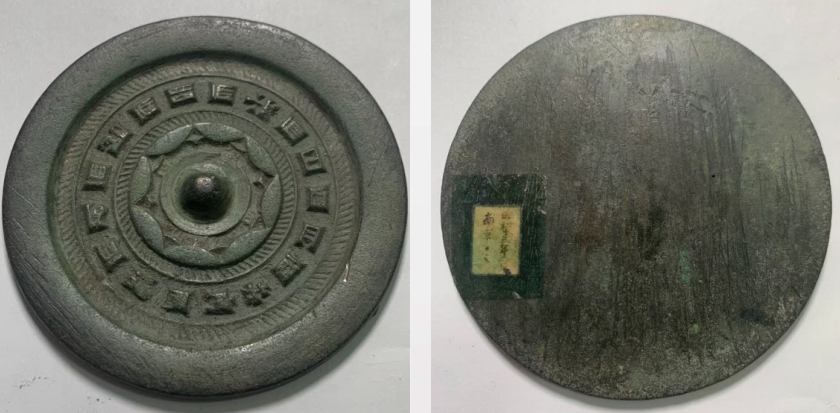
“This bronze mirror epitomizes the Japanese invaders' plundering of cultural properties in Nanking.” Meng Guoxiang stated that, according to historical records, the Japanese invaders’ plundering of cultural properties in Nanking was an organized and systematic state crime. This War of Aggression Against China not only resulted in massive casualties among the military and civilians in Nanking but also led to the comprehensive collapse of the city's infrastructure, economy, education, and cultural institutions, constituting a systematic war catastrophe.
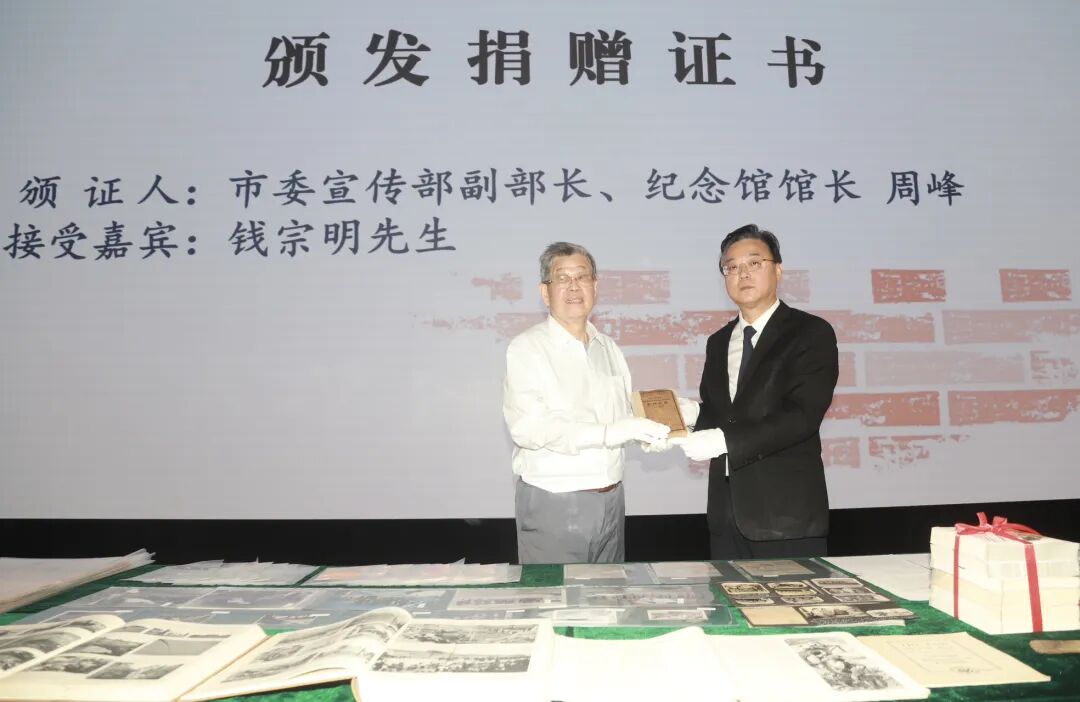
Qian Zongming, the former CPC Party Committee Secretary and Deputy General Manager of the Information Network Department atChina Telecom Corporation Ltd. Shanghai Branch, donated to the Memorial Hall the Trial Materials of Former Servicemen of Imperial Japanese Army Charged with the Manufacturing and Employing of Bacteriological Weapons, which had been preserved by his late father, Qian Guangsheng. The book was published in 1950 and is an important historical material for studying the Japanese army’s Biological Warfare.
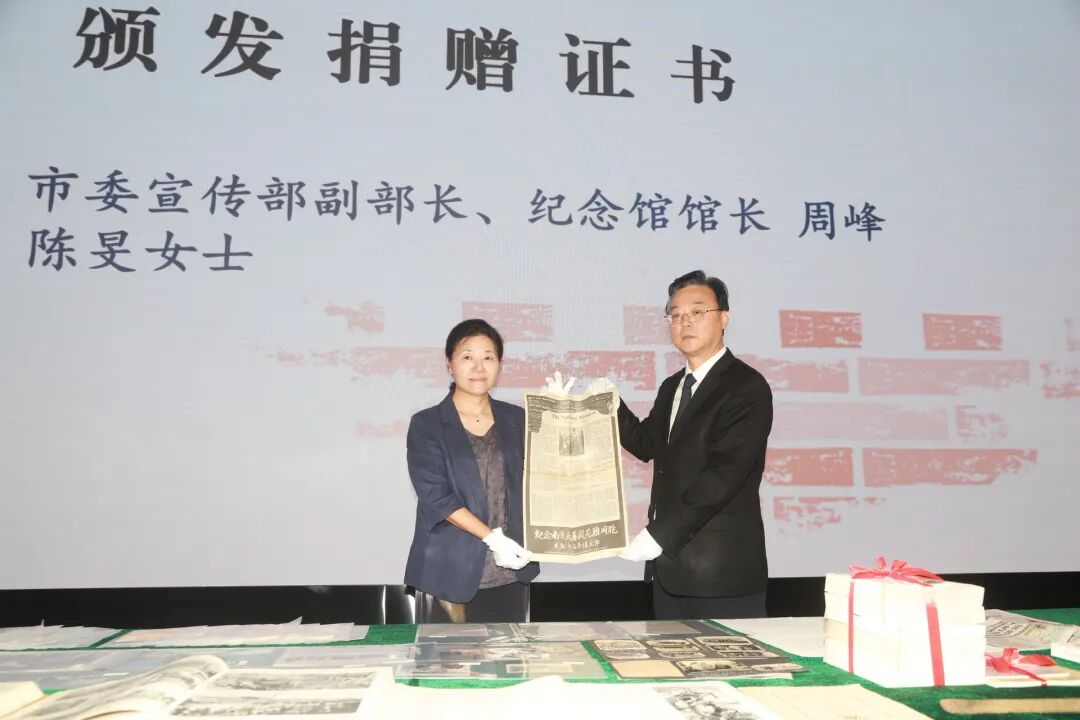
Xie Hua, Director of the Zhejiang Red Press Historical Materials Research and Study Center, donated to the Memorial Hall the series The Record of Japanese Aggression Against China in Old Newspapers, which he compiled and edited in 2015 to mark the 70th anniversary of the Victory of the Chinese People’s War of Resistance Against Japanese Aggression.

Chen Min, Head of the Jiangsu Correspondent Station of Hong Kong Ta Kung Wen Wei Media Group, donated to the Memorial Hall a photocopy of a statement on the significance of The Diaries of John Rabe sent by William C. Kirby, the Chair of the History Department at Harvard University, to the New York Association for Commemorating the Victims of the Nanjing Massacre on December 11, 1996. The statement reads:

No other text so profoundly captures the fear and despair experienced by the residents of Nanjing in the face of Japanese aggression. It is a shocking record of the horrors, bringing this tragic period of history vividly to life…
Wang Wei (stage name: Wang Weizhi), a faculty member at the Shanghai Film Academy, Shanghai University, donated his 2015 Chinese painting Restoring the Shatter Land to the Memorial Hall. The work integrates three forms of expression: performance art, painting, and poetry. The artist tore the parchment into more than 200 fragments, painting the face of one hero of the Chinese People’s War of Resistance Against Japanese Aggression on each piece and inscribing their name. He then reassembled the fragments and used cinnabar to trace red lines along the cracks. The work is intended to symbolize the heroes’ extraordinary feat of “stitching” the shattered land together with their lives and reforging the spirit of the Chinese nation.
