

Ironclad Evidence! Japanese Soldiers Expose Massacre Crimes
On the occasion of the 88th anniversary of the Nanjing Massacre, 13 items (sets) of cultural relics and historical materials reflecting the crimes committed by the Japanese invaders were incorporated into the collection of the Memorial Hall. On December 5, the Memorial Hall held the 2025 Newly Acquired Cultural Relics and Historical Materials Press Conference. Contributed by conscientious individuals from both China and abroad, these cultural relics and historical materials serve as a powerful rebuttal to Japanese right-wing forces. They provide irrefutable support for restoring historical truth and commemorating national suffering, and underscore the firm commitment of people at home and abroad to safeguarding historical memory and upholding justice and moral conscience.
Letters from Japanese Soldiers:
Atrocities Recorded by the Perpetrators Themselves
Two letters written by Japanese soldiers expose the atrocities committed during the Nanjing Massacre from the perpetrators’ own perspective. One of the letters, donated by a Japanese friend, is a four-page family letter written on January 8, 1938, by Murata Yoshio, a soldier of the 41st Infantry Regiment of the Kunisaki Detachment of the Japanese invaders, and addressed to his father, Murata Kitaro. Historical verification shows that the “Kunisaki Detachment”, to which Murata Yoshio belonged, was originally part of the Japanese 5th Division. After the occupation of Nanjing, the unit carried out mass killings in areas including Jiangpu, Pukou, and Jiangxinzhou.
Murata Yoshio recounted, in a chillingly casual and inhumane tone, the killing of Chinese captives following the occupation of Nanjing. He wrote: “In Nanjing, there is a rather ‘interesting’ execution pier where Chinese defeated soldiers and wounded prisoners are beheaded with katanas or shot every day, and their bodies are all thrown into the Yangtze River to be washed away. It’s such a thrill.” According to the Register of War Dead included in the History of the Fukuyama Regiment, published in Japan in 1978, the home address of Murata Yoshio matches that of the letter’s recipient. He died in action in China on April 16, 1938.
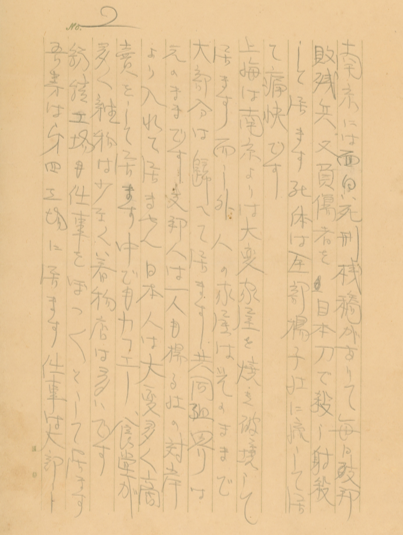
“This letter constitutes ironclad evidence of the atrocities committed by the Japanese invaders during the Nanjing Massacre, including both the killings and the disposal of the victims’ bodies.” Meng Guoxiang, a researcher at the Institute of National Heritage & International Peace, stated, “Murata Yoshio even used inhuman expressions such as ‘rather interesting’ and ‘such a thrill.’ It is evident that, during the Nanjing Massacre, the Japanese army treated killing as a casual and pleasurable act.”
Another letter was donated by Yu Ningpeng, a high school student from Xuzhou. It was written by a Japanese lieutenant named “Yamakawa” and sent on December 18, 1937, to “Yamakawa Tokutaro” in Fukushima Prefecture, Japan. The letter bears a postal stamp on the front marking the “Commemorating the Fall of Nanjing.”
The letter reads: “…Our destination, the capital Nanjing, was finally captured by us on the 13th. On the 17th, a grand ceremony was held for the entry of the military commander into the city, during which we were inspected. Please tell Masato-kun that I have found the most expensive mahjong set, which I will send him as a specialty gift.”
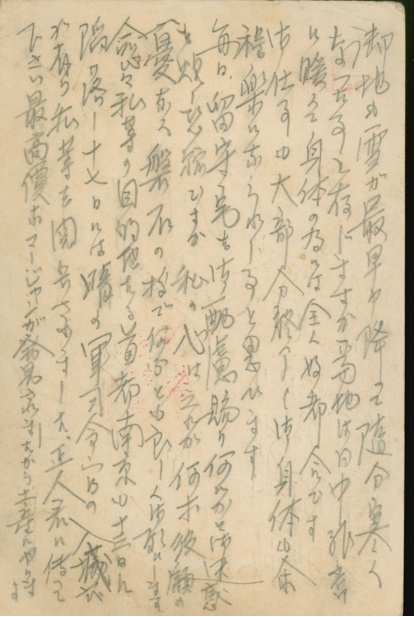
Based on information in the letter, such as the references to the “Yokoo Unit” and “Lieutenant Yamakawa,” historical verification indicates that this “Yamakawa” was Yamakawa Yoshito, the company commander of the 9th Company, 3rd Battalion, 19th Mountain Artillery Regiment of the 13th Division of the Japanese invaders. His military rank was lieutenant. The battalion departed from Zhenjiang on December 12, 1937, advanced along the southern bank of the Yangtze River, captured the Wulongshan Battery in its advance, and was stationed near Mufu Mountain in Nanjing.、
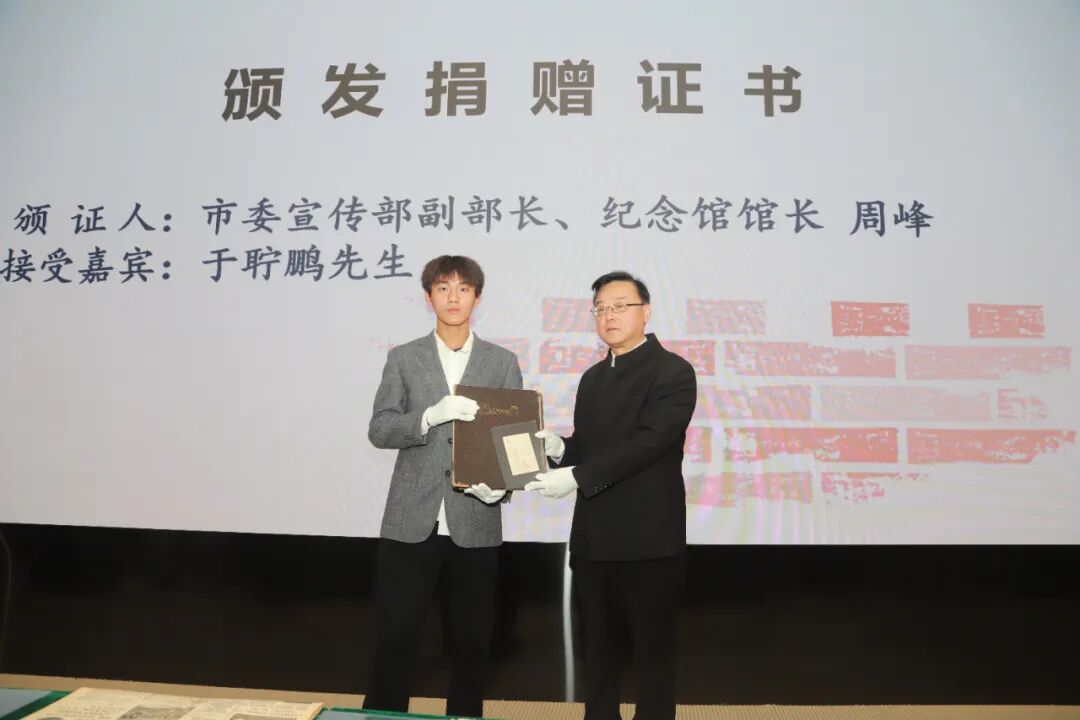
Yu Ningpeng donated the cultural relics to the Memorial Hall
Professor Meng Guoxiang participated in the research and verification work, and stated: “In the book The Nanjing Massacre: Battlefield Diaries of Japanese Soldiers, Fukuharu Meguro, a soldier of the 3rd Battalion, 19th Mountain Artillery Regiment of the Japanese invaders, serving alongside Yamakawa Yoshihito, explicitly recorded in his battlefield diary on December 17, 1937: ‘At 5 p.m., we carried out our mission, gunning down approximately 13,000 enemy soldiers.’ Another soldier of the battalion, Kurobe Tadanobu, also recorded in his diary the killing of prisoners along the Yangtze River on December 16, describing how they were “stabbed at will with bayonets.” Therefore, although the letter only documents Yamakawa Yoshihito’s participation in the December 17 Nanjing “entry ceremony” and looting a mahjong set, it serves as confirmation that Yamakawa and his battalion participated in the Mufu Mountain massacre.”
Historical Photographs: Captured Scenes After the Fall of Nanjing
Eight precious historical photographs, donated by father and son Dang Xiaoju and Dang Biao from Henan, vividly capture the scenes before and after the Japanese occupation of Nanjing. Some of the photos include the date taken and accompanying written notes.
This set of photographs includes iconic Nanjing landmarks such as Zhonghua Gate, Zhonghua West Gate, the Nanjing City Wall, and Changgan Bridge, which were damaged by Japanese artillery on December 14 and 15, 1937. The photos also document the Japanese “entry ceremony” into Nanjing on December 17, as well as the aggressive act of blasting operations carried out by the “Engineer Noguchi Unit, Tsuchiya Detachment”on December 12.
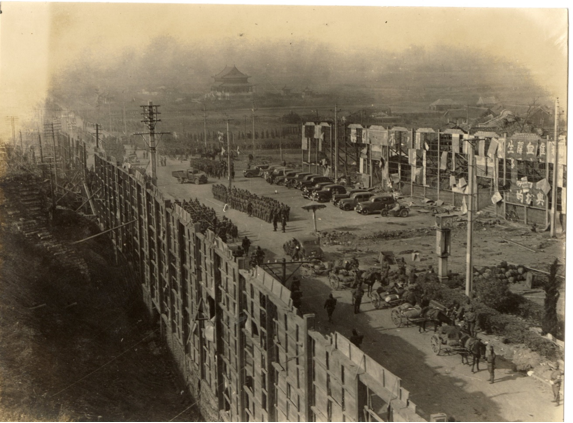
The Japanese army's Nanjing “Entry Ceremony” on December 17, 1937
One of the photographs, labeled “The road in Nanjing as seen at a glance: straight from Zhonghua Gate and then turn right to reach the city government,” shows the building on the right, which is the former Shanghai Commercial & Savings Bank, Ltd, now located at the northeast corner of Taiping South Road and Jiankang Road.
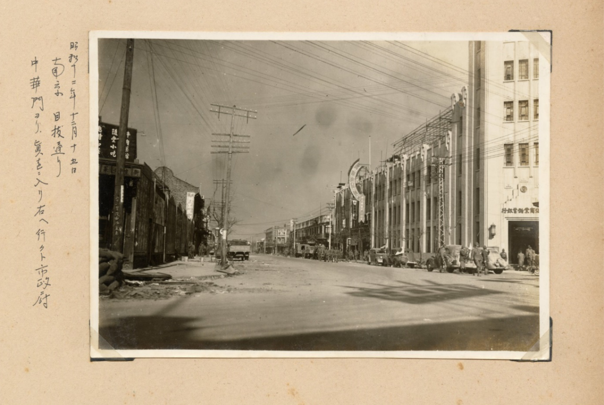
In particular, one photograph, labeled on the back “Near the dormitories on Tangshan Road, Nanjing (close to today’s Zhongshan Wharf) — the actual situation of children begging,” clearly documents the tragic circumstances of children begging on the streets under the occupation of Japanese invaders.
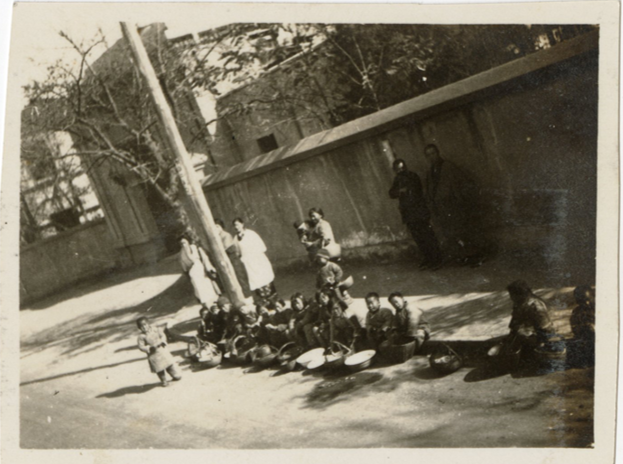
This set of photographs provides a vivid testimony to the devastating destruction inflicted on Nanjing by the Japanese invaders and the profound suffering endured by civilians during the war.
Archives of Patriotic Martyrs: Restoring the Story of a Military Doctor in the Battle of Nanjing
Mai Diyao, the son of military doctor Mai Zizhuang, who was killed during the Battle of Nanjing, donated three precious archival documents reflecting his father’s sacrifice: The Type B Investigation Form for Army Soldiers Who Died in Wartime, issued by the Military Affairs Commission of the National Government on July 19, 1940; The receipt for the pension application issued by the “Pension Office of the Military Affairs Commission stationed in Guangdong” on May 2, 1946; The reply letter from the “Guangzhou Headquarters of the Military Affairs Commission of the Nationalist Government”, dated September 28, 1946.
The Type B Investigation Form for Army Soldiers Who Died in Wartime clearly records that Mai Zizhuang held the rank of Second-Class Medical Warrant Officer, serving with the “Medical Unit of the 934th Regiment, 468th Brigade, 156th Infantry Division of the National Army”. He was a native of Nanhai County (present-day Dongguan City), Guangdong Province. He was killed in action during the breakout campaign in Nanjing on December 13, 1937, at the age of 29. The archives also document the names of his family members, including his father Mai Liangming, his mother Madam Cai, his wife Madam Mo, and his son Mai Diyao.
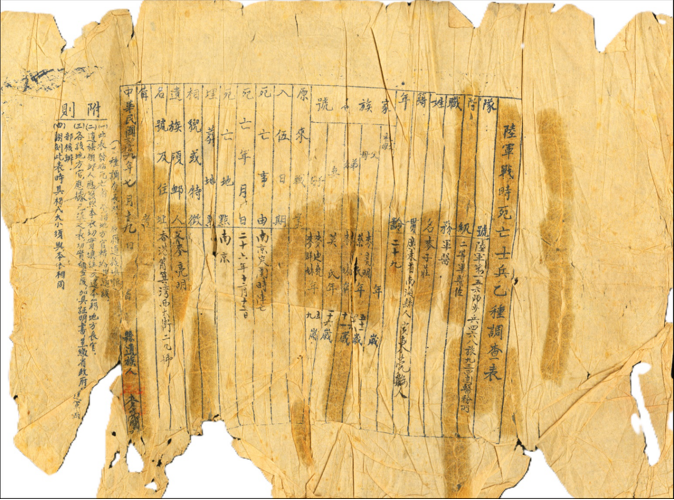
Mai Diyao, who now resides overseas, recounted that his father had settled in Hong Kong with his grandparents at an early age and later went to Guangzhou to study medicine. After completing his studies, he renounced the pen for the sword to serve as a military doctor. At his mother’s repeated urging, he returned to Hong Kong to marry, and shortly after the wedding, he immediately rejoined his unit. In December 1937, his father joined the Battle of Nanjing and subsequently lost contact with his family.
These archival materials not only reconstruct the loyal and courageous life of a military doctor who made the ultimate sacrifice for his country, but also serve as important historical evidence of the Battle of Nanjing.
British and French Publications: Exposing the Atrocities of Japanese Invaders from a Third-Party Perspective
An issue of the American magazine LOOK dated November 22, 1938, acquired by the Memorial Hall, features an article titled “Killing for Fun” on pages 54-55 and four photographs exposing the atrocities committed by the Japanese army.
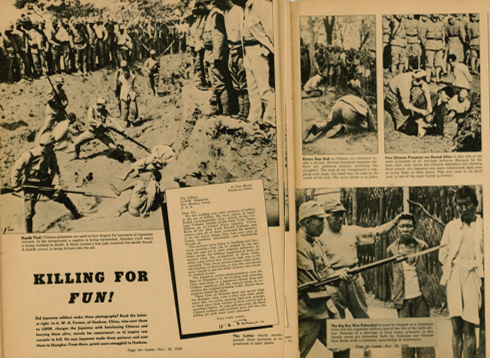
Chinese American Lu Zhaoning made his third visit to the Memorial Hall this year, donating a collection of English- and French-language publications that provide powerful third-party evidence of the atrocities committed by Japanese invaders.
On December 8, 1937, the French newspaper Excelsior reported on the population situation on the eve of Nanjing’s fall, noting that the city still had “as many as one million residents.” This account aligns with the testimony given at the Tokyo Trial by Dr. Robert Wilson, an American doctor at Nanjing Drum Tower Hospital. During the Tokyo Trial, the defense lawyers for the war criminals raised the issue of Nanjing’s population at the time of its occupation. Dr. Wilson testified that “the population had sharply declined to fewer than 500,000.”
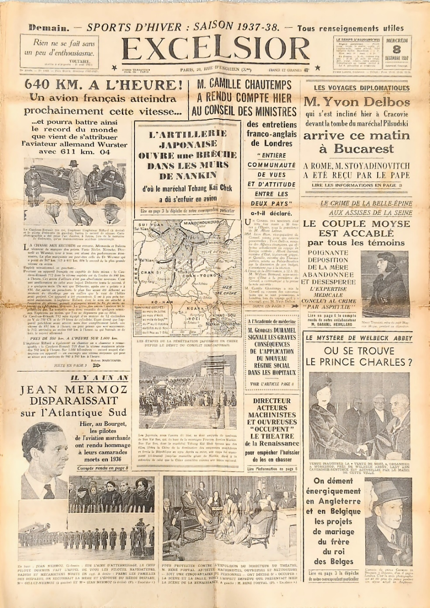
Professor Zhang Sheng of the History Department at Nanjing University and researcher at the Institute of National Heritage &International Peace stated: “In the postwar period, Japanese right-wing forces have long denied the Nanjing Massacre by questioning the population size of Nanjing, claiming that Nanjing had fewer than 300,000 residents at the time and that it was therefore impossible for 300,000 people to have been killed. This newspaper provides a strong rebuttal to the false claims of these Japanese right-wing forces.”
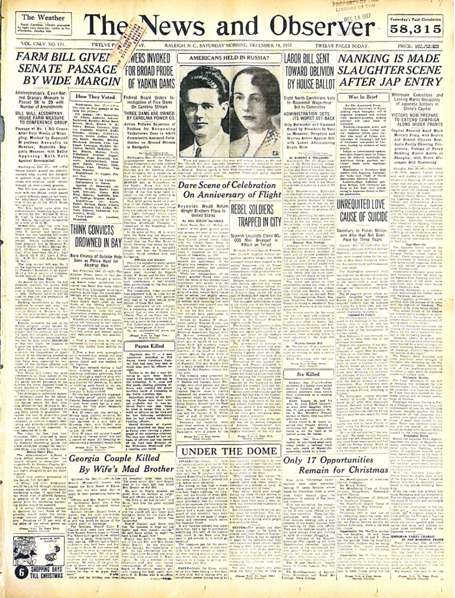
On December 18, 1937, The News and Observer reprinted an Associated Press report stating that “NANKING IS MADE SLAUGHTER SCENE AFTER JAP ENTRY.” At that time, many American newspapers carried the same report, indicating that the Nanjing Massacre was widely known internationally.
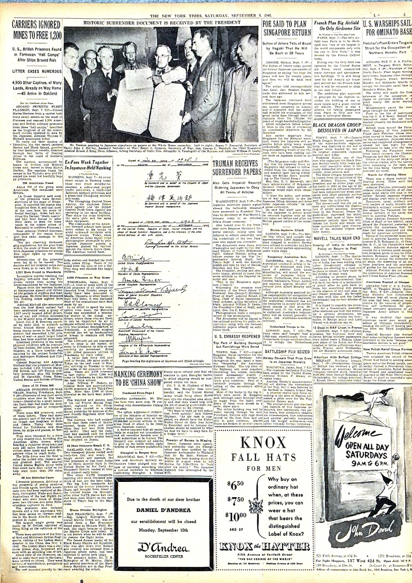
On September 8, 1945, The New York Times reported on the scene of September 2, 1945, in which Shigemitsu Mamoru and Umezu Yoshijiro, representing Japan, unconditionally surrendered aboard the battleship USS Missouri to representatives of various countries, including China’s Xu Yongchang.
Old Newspapers: Reporting on Witness Testimonies at the Tokyo Trial
Lu Zhaoning also donated a July 27, 1946 issue of La Voix (Peiping edition) to the Memorial Hall. This newspaper featured two reports related to the Tokyo Trial. In the Tokyo War Crimes Tribunal — Testimony of Wilson on the Nanjing Massacre reported Wilson’s courtroom statements: “The Japanese army burned Chinese civilians to death with gasoline, killed women and children with bayonets, and raped women.” “In the days following the Japanese entry into Nanjing, the Nanjing Drum Tower Hospital was filled with men, women, and children suffering from various injuries.”
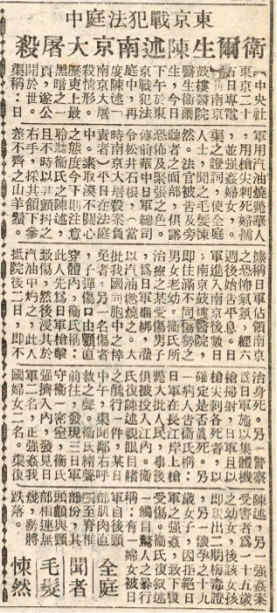
My Testimony Details the Atrocities of the Japanese Army reported the courtroom testimony of Xu Chuanyin, vice president of the Nanjing branch of the Red Swastika Society and head of the Housing Committee: “After the Japanese invaders entered Nanjing, they killed everyone they encountered.” “At that time, within the Nanjing city, there was no distinction between north, south, east, or west; the horrific scenes of Chinese civilians being massacred were everywhere, and the streets were filled with corpses.”
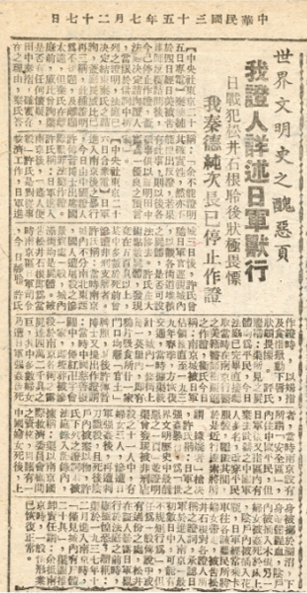
Professor Zhang Sheng stated: “These two reports faithfully reflect the attention paid by various sectors of society at the time to the Tokyo Trial and the atrocities of the Nanjing Massacre. The reports not only preserve the courtroom testimonies of Wilson and Xu Chuanyin in their entirety, but also vividly depict the disgraceful behavior of Iwane Matsui in court.”

Lu Zhaoning donated the cultural relics to the Memorial Hall
At the donation ceremony, Zhang Qing, the great-granddaughter of Xu Chuanyin and an inheritor of the historical memory of the Nanjing Massacre, donated the seal that Xu Chuanyin used during his lifetime to the Memorial Hall. In December 1937, Xu Chuanyin, serving as vice president of the Nanjing branch of the Red Swastika Society, joined the Nanjing Safety Zone International Committee and took charge of the Housing Committee. He opened his residence at No. 9 Emei Road as a refuge for refugees and also accompanied Reverend John Magee in photographing the site where Xia Shuqin and her family were victimized.
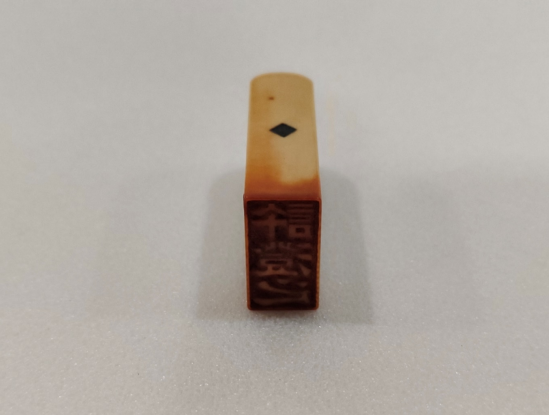
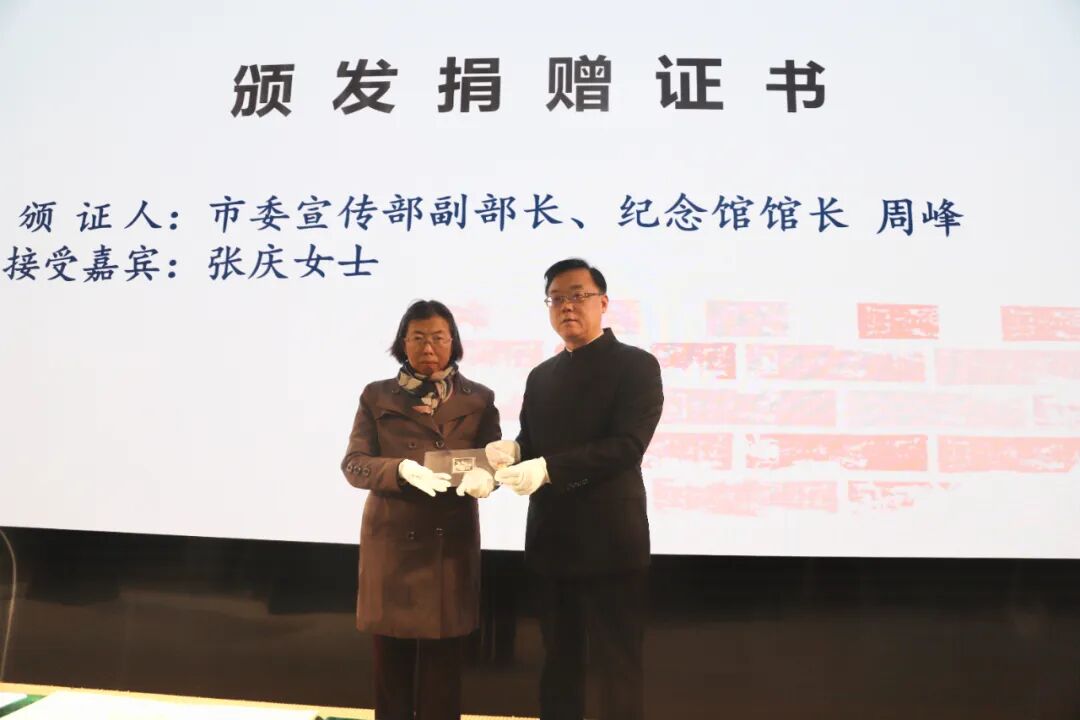
Zhang Qing donated the seal to the Memorial Hall
“Hanami Unit” Photo Album: Exposing the Japanese Invaders’ Destruction of Chinese Culture
The Japanese Invaders’ “Hanami Unit” Photo Album, donated by Yu Ningpeng, a high school student from Xuzhou, contains 44 photographs. It primarily documents the establishment of a field hospital by a unit of the Japanese North China Area Army in Tianjin. The photos clearly record the layout of the hospital’s laboratory, supply room, and wards, as well as the medical activities of the Japanese invaders and the situation of the hospital staff.
According to the information in the album, the unit was called the “Hanami Unit,” and the commanding officer’s surname was “Hanami.” After occupying Tianjin, the Japanese invaders mainly set up this hospital within Tianjin Fulun Middle School, which was founded in 1918. The photographs also show that the “Hanami Unit” established an infectious disease ward in the “Jinpu Railway Supplies Warehouse” and operated a “Hanami Unit Branch Office” within a certain building.
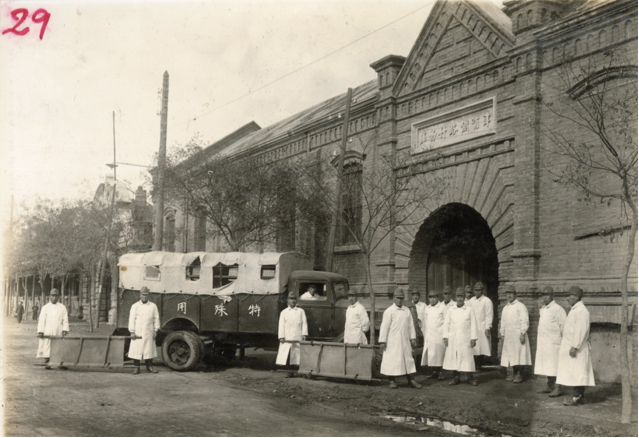
According to the 1940 book Mother Joins the Army by Iwai Setsuko, published by Japanese Women's Literary Society, the author Iwai arrived at the hospital in early October 1937 and served as head nurse. At that time, infectious diseases were prevalent, and the hospital had already admitted a large number of Japanese invaders suffering from cholera, dysentery, and other illnesses. In May 1938, the main forces of the “Hanami Unit” left Tianjin and headed to the front lines to participate in the Battle of Xuzhou.
Professor Meng Guoxiang noted: “This photo album reflects the Japanese invaders’ destruction of Chinese culture. The occupation of Chinese schools as field hospitals by the Japanese invaders was a plunder of China’s educational resources and a direct assault on and destruction of China’s cultural and educational institutions. During the war, universities such as Tsinghua University and National Central University were used as Japanese military hospitals. By the time of China’s victory in 1945, there were still more than 3,000 wounded and sick Japanese invaders in National Central University in Nanjing.”
Chinese Painting In Remembrance: Preserving Historical Memory Through Art
Wang Jiafang, a research librarian at the Shanghai Institute for Culture and History, a council member of the China Artists Association, and a national first-class artist, donated his Chinese painting In Remembrance to the Memorial Hall. The painting employs bold, textured brushwork to depict historical memory, incorporating key imagery from the Memorial Hall, such as the Peace Goddess Statue and the Monument to the Victims, while also including textual elements like “The Memorial Hall of the Nanjing Massacre Victims by Japanese Invaders,” “300,000 Victims,” and “1937.12.13-1938.1.”
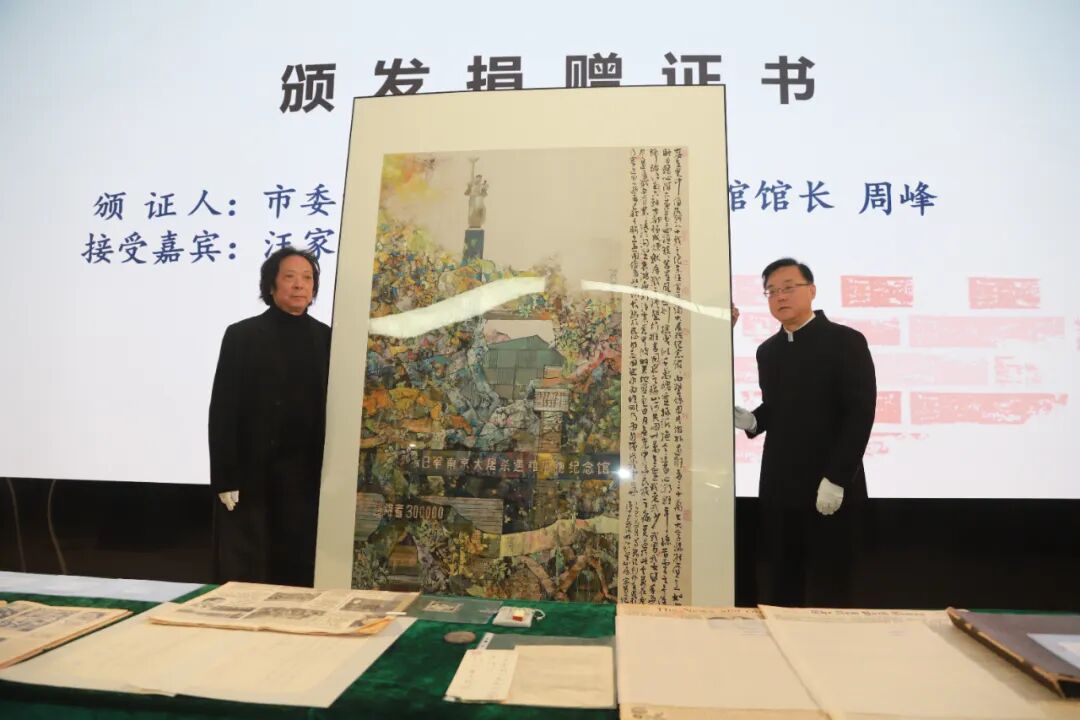
Wang Jiafang donated painting to the Memorial Hall
Wang Jiafang said: “Artists should pay attention to the nation’s history and development, celebrating the era with their brush and bringing history’s truths to light. Through this painting, I wish to help more people gain an understanding of history.”