

The "37-minute" Version Video Clip by John Magee Donated to the Memorial
On the afternoon of December 13, the 37-minutes version video clip filmed by the American missionary John Magee was donated to the Memorial Hall of the Victims in Nanjing Massacre by Japanese Invaders and the donation ceremony of the 1-inch disk was held.
This 37-minute version was found by Chinese-American Shao Ziping in 1991 in the basement of the house of David Magee, son of John Magee, and then copied and produced the contents of the atrocities by the Japanese invaders. It is among the various image versions of the atrocities by the Japanese invaders in Nanjing the most comprehensive version with the most abundant content. It is of great historical value.
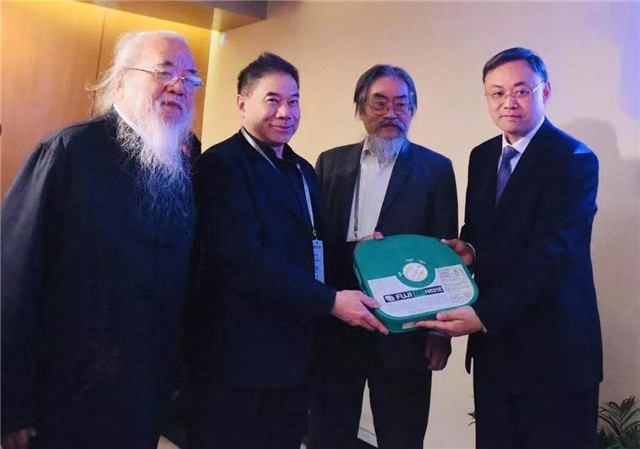
Patriotic Chinese such as Shao Ziping (second from right), Chen Xianzhong (first from left) and Jiang Guozhen (second from left) of the NanJing Massacre 1937 Memorial Foundation (NYC) donated the precious 37-minute version video filmed by John Magee to the Memorial Hall. First from right is the curator Zhang Jianjun
During the Nanjing Massacre, John Magee, an international friend, stayed in the city at the risk of his own life to record the films No. 1-12 with a 16mm camera, which remains the only moving images of the massacre ever found.
The first version of the film was No.1-4 brought from Nanjing to Shanghai in late January 1938 by international friend George Fitch. Fitch sent the film to Kodak in Shanghai and made four copies. The four copies were taken to the United States, Britain, Japan and Germany during the war to be broadcast and had wide international impact.
After Fitch left Nanjing, Magee continued to shoot, only with more content after. The images had recorded the detailed footage descriptions of films No.1 to 12, which have been kept by Magee himself.
In 1991, the NanJing Massacre 1937 Memorial Foundation (NYC) was founded in New York with Shao Ziping as its secretary general. On July 12, Shao visited David Magee and found a copper box containing the video film of the Nanjing Massacre in the basement.
David Magee then generously provided with all the footage, with a catalogue, that was then believed to record Japanese atrocities in China. Shao Zi-ping held a meeting with key members of the Foundation and sent the precious film to the film processing company to be transcribed into two sets of "one-inch disk" lasting about 37 minutes.
Content of the “37-minute” version
1. The first 11 minutes and 22 seconds reflect the situation of Shanghai after the Shanghai war.
2. The scene before the Japanese army occupied Nanjing, lasting about 1 minute and 23 seconds, mainly includes the Japanese bombing of Nanjing and refugees fleeing from Nanjing.
3. The Japanese atrocities scenes include the Japanese searching for young adults in Shanghai Road, the images of the medical staff of the Drum Tower hospital treating the victims of Japanese atrocities, the situation of the wounded and sick in the Jiangnan Cement Factory refugee camp clinic, and the scenes of the survivors, such as Wu Changde.
The increased content of the "37-minute" version images compared to the “17-minute” version
in the museum collection includes: a compatriot’s neck was cut in the Drum Tower hospital, the tragic experience of the family of survivor Xia Shuqin, and the moving images of survivor Wu Changde.
Experts believe that compared with previous version, the "37-minute" version has three features:
- From the perspective of length, the "37 minutes" version removed 11 minutes and 22 seconds of the image of Shanghai, and the repeated content in the "17-minute" version, while the actual image of Nanjing is about 9 minutes longer;
- From the perspective of spatial scope, most of the "17-minute" version were shot in the area of Nanjing Security Zone, with only a few shots of Qixia Temple and other suburbs of Nanjing. The "37-minute" version, however, went beyond the scope of the security zone, to outside the city. According to historical records, on February 16 and 17, 1938, Magee went to Qixia Temple and Jiangnan Cement Factory refugee camp in the eastern suburbs of Nanjing. In the "37-minute" version, there were scenes of the wounded being carried to the clinic of Jiangnan Cement Factory and the wounded in the clinic, which were more abundant than the "17-minute" version;
- From the perspective of scene scope, in the "37-minute" version, more than 30 victims were filmed in the Drum Tower Hospital, of which 11 were missing in the "17-minute" version. There are images of Wu changed the survivor, and a woman who has had her neck cut off and is being examined by Dr. Robert Wilson in the hospital.
Professor Zhang Lian-hong, director of the Nanjing Massacre Research Center at Nanjing Normal University and researcher of the Research Institute of Nanjing Massacre History & International Peace, said the donation of the "37-minute" version of the Magee’s film is of great significance:
First, this version is one of the most comprehensive and informative versions that have been found so far, reflecting the atrocities committed by the invading Japanese forces in the Nanjing Massacre, seen from, for example, the number of victims in the Drum Tower Hospital, moving image of the survivor Wu Changde, and how Xia Shuqin's family suffered at the scene, and so on.
Second, it has important cultural relics and historical data value. After the Foundation discovered the films, and made the "one-inch disk", documentaries such as American Missionaries Eyewitnesses to the Nanjing Massacre and In the Name of the Emperor were widely distributed and presented to many libraries around the world, and had a very wide international impact. In the 1990s, when Japanese right-wing forces were rampant to have denied the words and deeds of the Nanjing Massacre, the documentaries undoubtedly vigorously fought back against their arrogance. There is no doubt that this original "one-inch disk" itself has very important cultural relics and historical value.
Professor Zhang also said that in October 2002, under the strong promotion of the Foundation, John Magee's son David Magee donated the camera and four boxes of film to the Memorial. The "17-minute" version that the Memorial now has was images obtained by digitizing the film donated by David Magee at the Shanghai Film Studio and their value of cultural relics cannot be replaced.
The "17-minute" version of maggie's images is a collection of images obtained by digitizing the film donated by David maggie at the Shanghai film studio.
In October 2015, the Documents of the Nanjing Massacre was included in the Memory of the World Register, and it was exactly the "17-minute" version filmed by John Magee that played an important role, which is one of the most direct and powerful evidences of the Nanjing Massacre.
Chen Min, Chief of Jiangsu Bureau of Hong Kong Ta Kung Wen Wei Media, and Li Qingyi, former deputy editor-in-chief of Wen Wei Po Hong Kong, made an exchange at the donation ceremony.
Chen said that in January 2018, when she was collecting and writing of Shao Ziping looking for Magee’s film, she repeatedly verified that the footage of the Nanjing Massacre in the "37-minute" version was longer than that in the Memorial’s collection. In the pursuit of Ta Kung Wen Wei Media, Shao Zi-ping and other patriotic Chinese found the "37-minute" version of maggie in New York in October 2018.
On October 22, 2018, Shao came to the Memorial and donated a 58-page handwritten research record of Magee film. Word spread that the "37-minute" version of had been found and there were people asking and expressing the desire to buy it.
Zhang Jianjun, curator of the Memorial, learned about this and arranged for the Memorial staff to closely contact Shao Ziping and the Foundation. In the end, the Foundation decided to give the 37-minute version to Nanjing, where the historical event took place.
Invited to attend the ceremony were descendants of John Magee - Chris Magee and Rick Magee, oversea Chinese Lin Boyao, Chinese-Germans, Shao Hua - librarian of the East Asia Department of Ruhr University of Bochum, and experts on the history of the Nanjing Massacre.

Chris Magee (first from left) and Rick Magee (second from left)
Chris Magee said: "My grandfather stayed in Nanjing 82 years ago to protect the refugees and filmed the atrocities of the Nanjing Massacre by Japanese invaders. He wanted to show the world what happened in Nanjing. I think it is very meaningful for people to see the film taken by my grandfather in Nanjing after so many years."
Rick Magee said: "I am very proud of my grandfather helping refugees in Nanjing. His experience had a great impact on me. I will continue to tell westerners I meet my grandfather's stories of the greater love for the rest of my life."
Also at the donation ceremony, Ms. Shao Hua donated a notarized document to the Memorial made by Mrs. Ursula Reinhardt, granddaughter of John Rabe, publishing The Diaries of John Rabe.

In December 1996, Mr. Rabe's granddaughter, Mrs. Ursula Reinhardt, published in New York The Diaries of John Rabe about the Nanjing Massacre, which had been kept in the dust for nearly 59 years.